
Boosting Posts vs. Facebook Ads: What’s the Difference?
If you manage a business Facebook page, you’ve probably noticed the “Boost Post” button that appears under many of your posts. It’s quick, easy, and tempting to click when you want more people to see what you’ve shared. But boosting a post and running a Facebook ad are not the same thing. Both involve paid promotion, yet they work in different ways and serve different purposes. Understanding the difference can help businesses decide which option makes sense depending on their goals.
What Boosting a Post Does
Boosting a post is the simplest way to pay Facebook to show one of your existing posts to more people. When you click the Boost button, Facebook walks you through a short setup process where you choose a budget, a duration, and a basic audience.
Boosting is essentially about expanding the reach of a single post. It takes something that already exists on your page and shows it to more people beyond your current followers.
Businesses often boost posts when they want to:
- Promote an event
- Highlight a special offer
- Share an announcement
- Get more engagement on a post that is already performing well
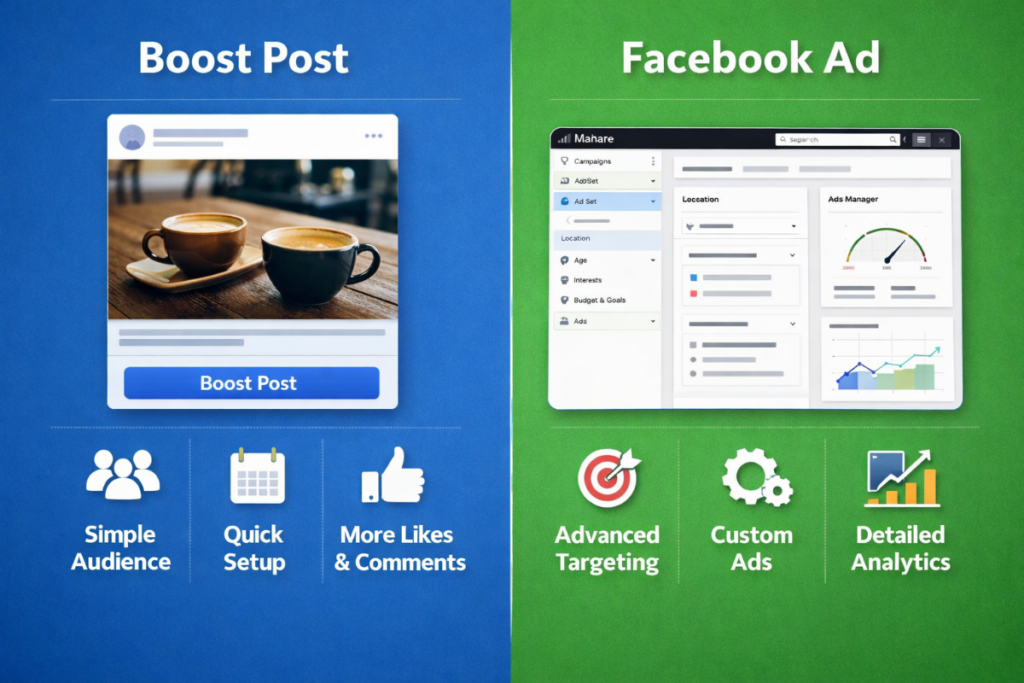
The setup is quick and requires very little technical knowledge. Because of that, boosting can be useful for simple visibility or for increasing likes, comments, and shares.
However, boosting also comes with limitations. Targeting options are basic, campaign objectives are limited, and the advertiser has less control over how the promotion is delivered.
What Facebook Ads Do
Facebook ads are created through Meta’s Ads Manager rather than the Boost button. While boosting focuses on promoting a post, Facebook ads allow businesses to build a structured advertising campaign with specific objectives.
When creating an ad campaign, the advertiser first selects a goal.
Example goals include:
- Website traffic
- Lead generation
- Video views
- App downloads
- Sales or conversions
From there, ads can be designed specifically for that objective rather than simply promoting an existing post. Facebook ads also allow for much more detailed audience targeting.
Advertisers can target people based on:
- Location
- Age and demographics
- Interests and behaviors
- Website visitors
- Customer email lists
- People similar to existing customers
This level of targeting allows businesses to reach very specific audiences instead of simply showing a post to a broad group of people. Facebook ads also allow businesses to upload their own customer lists, such as email databases, so ads can be shown to past customers or people similar to them.
Creative Options and Ad Formats
Boosted posts are limited to the format of the original post. If the post contains an image, video, or link, that is what will be promoted. Facebook ads offer a wider range of formats designed specifically for advertising.
Ad formats include:
- Carousel ads with multiple images
- Video ads
- Lead form ads
- Collection ads
- Story ads
Because these formats are designed for advertising campaigns, they can be better suited for guiding users toward a particular action, such as visiting a website or signing up for more information.
Budget and Performance Control
Boosting a post typically involves selecting a total budget and the number of days you want the promotion to run. Once it begins, there are fewer controls for adjusting delivery or testing different approaches.
With Facebook ads, advertisers can monitor performance more closely and make changes while a campaign is running.
For example, with ads you can:
- Test different audiences
- Compare multiple ad designs
- Adjust budgets between ads
- Track specific results such as website clicks or purchases
This type of control can be especially useful when a business is trying to optimize a campaign or measure return on investment.
When Each Approach Makes Sense
Boosting posts and Facebook ads are both useful tools, but they serve different roles. Boosting posts works well when the goal is simple: increasing visibility or engagement for a particular post. It’s quick to set up and easy to manage. Facebook ads are better suited for structured campaigns where a business wants to achieve a specific outcome, such as generating leads, driving traffic to a website, or reaching a carefully defined audience.
Both boosting posts and running Facebook ads involve paying to reach more people on the platform. The key difference lies in how much control, targeting, and campaign structure the advertiser wants. Boosting posts offers a fast and simple way to expand reach. Facebook ads provide a more advanced system for targeting audiences, testing creative, and pursuing specific marketing objectives.
Understanding the distinction helps businesses use each tool more effectively and choose the approach that best fits their goals.