Total Local Marketing

Print Advertising

Rule of Thirds

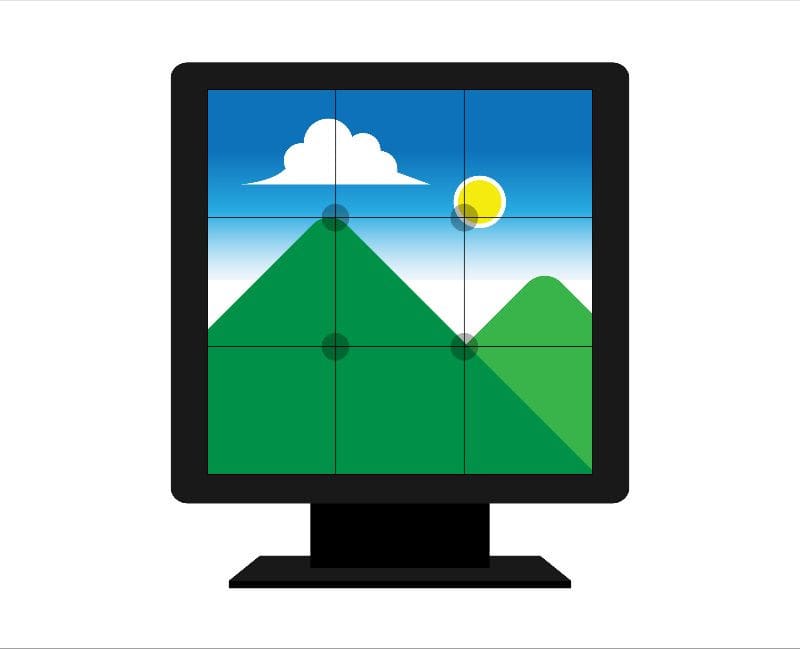
Why Some Designs Just Work: The Rule of Thirds Explained If you’ve ever looked at a photo, ad, post, or website and thought, “That just feels right,” there’s a good chance the rule of thirds was at work. This classic design principle shows up across graphic design, photography, social media, and UX design because it aligns with how people naturally scan and absorb visual information. The beauty of the rule of thirds is its simplicity. You don’t need advanced tools or design training to apply it well — just a basic understanding of how visual balance works. What Is the Rule of Thirds? Picture a layout divided into nine equal sections using two horizontal lines and two vertical lines. The rule of thirds suggests placing important elements along those lines or at their intersections instead of centering everything. This approach creates balance without symmetry. It gives designs a sense of movement and structure, helping the eye travel naturally from one element to the next. Graphic Design: Creating Clear Visual Hierarchy In graphic design, the rule of thirds helps establish order. Headlines, images, logos, and calls to action are easier to process when they’re given their own space. Placing a headline near the top third, a supporting image along one side, and key details near a lower intersection guides readers through the design without confusion. This is especially effective for ads, flyers, postcards, and email graphics, where space is limited and clarity matters. Photography: Making Images Feel Natural Photography is one of the most common places you’ll see the rule of thirds in action. Centered subjects can feel formal or static, while off-center placement adds interest and depth. Aligning a subject’s eyes with the top third or placing a horizon along the lower third creates a more dynamic image. This technique is widely used in lifestyle photography, product shots, and brand imagery because it feels authentic and approachable. Social Media Graphics: Stopping the Scroll On social media, the rule of thirds is especially powerful. Graphics that place text, faces, or focal points slightly off center tend to feel more modern and intentional. Leaving space in one third of the image for text while anchoring visuals in another keeps posts readable and visually appealing, especially on small screens. It also helps ensure that important elements aren’t covered by platform overlays or cropped in previews. UX Design: Supporting How People Navigate In UX design, the rule of thirds supports usability. Websites and landing pages that place key content along natural viewing paths are easier to scan and interact with. Users don’t read screens line by line — they scan. Aligning headlines, images, and buttons with the rule of thirds subtly guides attention and encourages action without overwhelming the viewer. Knowing When to Bend the Rule Experienced designers can break the rule of thirds because they understand why it works in the first place. When balance, hierarchy, and visual flow are intentional, stepping outside the rule can create emphasis or interest rather than confusion. Without that foundation, breaking it often feels accidental instead of purposeful. Why It Just Works Used thoughtfully, the rule of thirds brings clarity, balance, and ease to almost any visual, whether print or digital. By aligning layouts with the way people naturally scan and process information, it helps designs feel more intuitive, reduces visual strain, and makes key messages easier to notice without needing extra explanation.


mail

Ready to Be Remembered?

The Power of Print: Why Direct Mail Still Delivers Cut Through the Digital Clutter  In a world filled with digital content, direct mail truly stands out. For small and mid-sized business owners, it remains one of the most effective and affordable ways to connect with potential customers in a personal, memorable way. Tangible, Trusted, and Attention-Grabbing  Unlike emails that may get lost in cluttered inboxes or online ads that are quickly scrolled past, direct mail puts your message directly in your audience’s hands. A well-designed postcard, brochure, or letter captures attention, builds trust, and encourages action, especially when paired with strong calls to action and eye-catching design. Smart Targeting, Big Impact Direct mail also offers targeting flexibility. Whether you’re using Every Door Direct Mail (EDDM) to blanket a neighborhood or a curated mailing list to reach specific demographics, direct mail allows you to focus your budget on the people most likely to become customers. You can even reinforce your message by aligning it with your digital marketing strategy for a stronger, more consistent brand presence. Longer Shelf Life Than Digital Ads And here’s another bonus: direct mail has staying power. Recipients often hang onto physical pieces, display them on fridges or desks, or pass them along to others, giving your message more life than a fleeting electronic impression. Let’s Get Mailing Make the most of your direct mail efforts, whether it’s through oversized postcards, personalized letters, or targeted campaigns designed to complement your online marketing. If you’re looking for a proven way to stand out, boost engagement, and reach your community where they live, direct mail might be the edge your business needs.

Print Materials

Print Packs a Punch!

Print Still Matters: Why Consistent Branding in Print Materials Is Essential In a world full of digital media, it’s easy to overlook the power of print — but for small and mid-sized businesses, printed materials still play a crucial role in creating strong, lasting impressions. Print offers a sense of credibility and reliability, which helps build trust with your audience. From business cards and brochures to yard signs and invoices, every printed piece your business puts into the world is a direct reflection of your brand. Consistency Builds Credibility and Recognition  That’s why consistent branding across all your print materials is so important. When your business card matches the look and feel of your brochures, signage, and even your invoices, it helps build trust and recognition. Customers are more likely to remember your business — and take it seriously — when everything looks polished and cohesive. Think of your printed materials as the “leave-behind” that sticks with people long after the conversation ends. A well-designed business card can spark a follow-up call. A professionally printed brochure can turn a maybe into a yes. Even your invoice, with a clear logo and consistent font, reinforces your professionalism and brand identity. Make a Big Impact with Small Details Small and mid-sized businesses don’t need massive marketing budgets to make an impact — just attention to detail and a commitment to consistency. Matching colors, fonts, logos, and messaging across all formats creates a seamless experience that makes your business look confident and credible. Print materials are memorable, tangible, and create multiple opportunities for customer engagement and they allow consumers to browse your full range of products in a relaxing, physical format. Print Works Well with Digital At the end of the day, print doesn’t compete with digital — it complements it. Adding QR codes, website URLs, and social handles to your print materials bridges the gap and drives people to your online presence. In short, print is far from dead. It’s a trusted, proven tool that builds connections, credibility, and brand visibility in a hands-on way. When done right, print makes a lasting impression and helps your business stand out in a noisy, fast-scrolling world.

Magazines

Everyone’s Door, Your Message

Print Powers Connection: Reaching Your Community in a Fragmented Media World In today’s media landscape, reaching a broad audience has never been more challenging. Streaming platforms, social media algorithms, and niche digital channels divide audiences, leaving advertisers struggling to cut through the noise. While print advertising — especially in community magazines and business directories distributed through Every Door Direct Mail (EDDM) — offers a proven solution. By delivering physical materials directly to every household, print connects with everyone in the community, ensuring your message reaches its mark. Reliable Community Coverage  Unlike digital campaigns, which depend on algorithms and user behavior, print materials are delivered directly and reliably. This ensures comprehensive community coverage, making it an ideal choice for businesses aiming to connect with all demographics in a community. Magazines and directories can cut across generational and digital divides, providing broad and inclusive reach. Community Magazines Lend Depth and Trust These publications are often kept, revisited and shared, giving your message a lasting presence. Readers engage with magazines not just for the ads but for the stories and local insights, creating a stronger connection between businesses and their audiences. Magazines allow advertisers to integrate their messages seamlessly with valuable community content, fostering trust. Business Directories are Practical Print Advertising  Often print publications include a business directory. These year-round resources ensure your business is easy to find when someone needs local services. Their organized and accessible format, combined with the credibility of being included in a trusted local resource, makes directories indispensable. Print is Tangible while Digital is Fleeting A physical presence in the hands of your audience means greater memorability and less competition compared to crowded digital spaces. Print appeals to a wide range of people, from those who appreciate its traditional format to those who value its uniqueness in a digital world. By integrating community magazines, business directories, and EDDM, print advertising provides a unified approach to a fragmented media environment. It ensures broad reach, builds trust, and delivers long-lasting impact. For businesses aiming to establish meaningful connections and rise above the digital clutter, print remains a reliable and effective choice.

Print Media

Print Packs a Punch

Print is More Memorable & Trustworthy Than Other Forms of Advertising Print Remains a Powerful Medium Despite the rapid growth of digital media, print continues to stand strong as an essential and effective marketing channel. While it may not be the latest trend, print’s enduring benefits make it indispensable. One of the key advantages of print is its tangibility. Unlike digital media, print can be held, passed around, and revisited at any time. With the influx of emails and online advertisements, homeowners’ mailboxes are less cluttered, increasing the likelihood that your print advertisement or publication will be seen and remembered. Print Inspires Trust Trust in advertising is crucial, and print consistently outperforms digital in this area. According to a MarketingSherpa survey, 82% of U.S. internet users trust print ads more than any other form of advertising when making a purchase decision. This level of trust may stem from print’s long-standing reputation for reliability and the permanence of seeing something physically printed. As a result, using print media can lend your brand a sense of credibility and authenticity that is difficult to achieve through digital-only campaigns. Print Reaches Key Audiences Print still holds a special place in the hearts of many, especially among certain demographics. Recent research on directory advertising reveals that 46% of people start their local searches in print rather than online. Additionally, the majority of these print users are in the 55+ age group—a demographic that controls 75% of the nation’s wealth. This makes print a valuable tool for reaching an audience with significant purchasing power, ensuring your message gets in front of the right people. Print Is More Memorable Studies also show that print leaves a more lasting impression than digital media. People are more likely to recall information they’ve read in print than information consumed on a screen. This could be due to the multi-sensory experience print provides—its weight, texture, and permanence make it easier for readers to engage with and retain the content. What’s more, printed materials often have a longer lifespan; magazines and brochures can sit on a coffee table or desk, giving them multiple opportunities to be viewed. Harness the Power of Print Print media offers a versatile array of opportunities for reaching your target audience. From direct mail campaigns to trade shows, directories, conferences, newspapers, and magazines, print can be used in many different settings, amplifying your brand’s message. When combined with digital efforts, print becomes even more impactful. At the end of the day, print’s ability to inspire trust, reach key audiences, and provide a memorable experience ensures that it remains one of the most effective and lasting marketing channels available. By investing in print, you can harness its timeless power to connect with your audience in a meaningful, trustworthy, and enduring way.

Display Advertisers

Digital Enhancements for Our Display Advertisers

Our Display Advertisers Get Found Online Total Local Community Guides are an effective advertising media for our display advertisers since they are sent to every resident in a community through Every Door Direct Mail. However, since so much of our world has become digital, we also want to help our display advertisers get found online. That’s why we’ve recently launched new digital enhancements for all of our print advertisers. With a display ad, our advertisers also get these items online: A featured listing of each display ad on every community website page in which they advertise. A unique business profile page on our website with their contact information and ad. We also publish each community guide in a flippable format online at ISSUU.com and link display ads back to advertiser websites. 3 posts per year on our Total Local Facebook page for each community in which they advertise. These posts point back to advertiser websites and include their contact information. NEW! We’ve added enhanced Business Profile Pages on our website for any display advertiser that purchases a half page and above for free! Or, if you are a smaller display advertiser or would just like to be an advertiser on the website for a particular guide, you may purchase an Enhanced Business Profile Page. Enhanced Business Profile Pages on Total Local Our website includes a section for each of our communities where we publish a Total Local Community Resource Guide. On the Community Guide Page, we include an image of all of our display advertisers, which is clickable through to their Business Profile Page. Any of our advertisers that purchase the equivalent of a half page or above in display advertising in our books receives an Enhanced Business Profile Page. The enhancements include digitizing their ads by inserting key words of their products and services on the page. We can also add more text information that the advertiser provides. Plus, we link back to the advertiser’s website, google listing, or social media accounts. All of this helps contribute to the advertiser’s overall search engine optimization. We’ve started rolling these improvements out this fall with our summer guides, starting with Mason. Moving forward we will be adding these enhanced pages to each new Community Resource Guide. Total Local Community Facebook Pages For all of the communities where we publish a guide, we also host a community resource page on Facebook. This page not only features each of our display advertisers (for free) three times per year, but we also repost community events, local news, and more. Our pages for each community are not meant to compete with other community Facebook pages and groups. They are simply another way for local businesses and community information to reach more people on Facebook. These days, local information often gets drowned out by well-funded news sources and big-name brands. With Total Local Facebook pages, we focus on the businesses and events in your own community. We know that fostering a community connection helps businesses become more recognized by their customers. Creating a sense of community also encourages people to shop local, building up the community’s economy and creating a win/win situation for both residents and business owners. So, advertising with Total Local covers all your bases. Through our printed guides and our community Facebook pages, we provide you with a multi-faceted approach to reaching your audience. Your display ad in our Total Local Community Resource Guides will reach people in their mailboxes via Every Door Direct Mail. In addition, by giving our advertisers exposure on our community Facebook pages and with our Enhanced Business Profile Pages on our website, we have also provided them with a crucial way to be found online! Contact Us If you’re interested in advertising in Total Local’s Community Resource Guides or in an Enhanced Business Profile on our website, please contact us at 517-663-2405.

Community Resource Guides

Print Continues to Provide a Return on Investment

Print Ads are More Memorable and Lend Credibility Print continues to be a strong advertising media, despite all the naysayers. Though we all know that print is not an up-and-coming marketing channel, its benefits are essential and have stood the test of time. Print continues to be a crucial way to reach your audience. Research shows that people still respond to direct mail at cost-effective rates. Print is tangible in a way that electronic communication is not. Plus, with the advent of email, there is less and less in a homeowner’s mailbox for advertisers to compete with, making your print advertisement more likely to be seen. And, because of the valuable information in our community resource guides, they are more likely to be kept all year long for reference, unlike other forms of direct mail. Print Inspires Trust One of the most important benefits of print media is the trust factor. A recent survey by MarketingSherpa finds that 82 percent of U.S. internet users trust print ads when making a purchase decision, more than any other form of advertising. Maybe it’s because of the timeless nature of seeing something in print, but a print ad is a great way to give your brand a classic sense of credibility. Plus, because it is something they can actually hold in their hands, people are more likely to remember an ad they have seen in print. Print’s Target Audience Despite the prevalence of digital options, many people still reach for paper when searching for local information. We’ve come across recent research regarding directory advertising that shows that 46% of people still start their searches in print, rather than online. Also, a majority of the people searching in print are in the 55 plus age group, who happen to own 75% of the nation’s wealth. If this is your target audience, you’re missing out on reaching a large segment of these folks when they are searching for a business if you aren’t advertising in print. Our Readers See Your Ad More Than Once Because our community resource guides are used as a reference for lots of valuable local information, some readers will see your print ad on a regular basis.  And, because the guides are sent to local households in your community, it is easy to know you are reaching your target audience. In a recent survey, we found that 22 percent of respondents use our guides at least weekly, 33 percent use them monthly, 28 percent use them occasionally, and 17 percent look through them at least once. With a majority of respondents using our directories more than once, advertising in Total Local Community Resource Guides is not only a great way to reach customers, but also helps provide each community with valuable local information about their government, schools, emergency services, organizations, history, parks, and more! At the end of the day, print is still one of the most powerful and lasting ways to reach your audience and promote your business. The tangible, timeless benefits of print advertising are here to stay. Contact Us If you’re interested in advertising in Total Local’s Community Resource Guides, please contact us or call 517-663-2405.

High Resolution

The Importance of High Resolution Images for Print

High Resolution Images Versus Low Resolution Images When working with photos, it is important to know that there is a difference between how they look online versus how they look when they are in print. That is because digital media works differently than print media. This can be confusing, because the world of digital photography has made it so easy to take photos and post them online. A photo can look great on your computer screen, or on your phone’s Facebook feed, yet when it is printed out, that very same photo might look blurry or choppy. The reason for this difference between online photos and printed photos is in the resolution of the image. Resolution describes the amount of detail an image has. The higher the resolution, the more detail. Photos that are intended for online viewing don’t need nearly as high resolution as photos intended for print. In fact, low resolution images are actually preferred for online, since they take up less file space and load more quickly. But, these low resolution images are very difficult for designers trying to make them look good in print. One quick way to know if a photo is going to look pixelated in print is to zoom in on it. If it starts to look blurry or choppy as you zoom in, that’s a good indication that it is a low resolution image: fine for online, but not so good for print. About Resolution, Pixels, & Dots per Inch Also, some basics about resolution might help you decide if your photo is fit to print. There are a couple of terms people use to describe resolution. One of them is “pixel.” Pixels are used to describe how much detail or information an image has. The more pixels, the more detail. When an image doesn’t have a high amount of pixels, it will appear “pixelated,” where the image looks like a bunch of squares joined together. (Kind of like the earliest video games used to look!) With printed images, a common term people use to describe resolution is DPI, or “dots per inch,” referring to the tiny dots on paper that make up an image. A pixel in a digital image is the equivalent of a dot in a printed one. Many online photos are 72 DPI, and they look really good on a computer monitor or a phone screen. However, 72 DPI is considered low resolution for print media, and would look blurry and pixelated when printed. If you want a photo to look sharp and vivid when printed, a general rule of thumb is that it should be at least 300 DPI. To give you an idea of the size of file a high resolution photo would be, a 3 x 5 inch photo, at 300 DPI, is usually about 1 MB (megabyte), while a full page photo, at 300 DPI, is usually about 3 MB. Sometimes it can be easier to figure out the size of photo you need by measuring your pixels. If you don’t mind a little math, you can convert from pixels to DPI pretty easily, to help you with sizing your photo. For example, if you want a 4 x 6 inch printed photo to have 300 DPI, your photo would need to be 1200 (4 x 300) pixels on its short side, and 1800 pixels (6 x 300) on its long side. So, it needs to be at least 1200 x 1800 pixels in size. When in Doubt, Save In Higher Resolution When in doubt, if you know your photo is going to be used for print, save it in the highest resolution format you can. Your graphic designer can always reduce the size of your photo, but it’s very hard to increase the size and the resolution, while maintaining the quality. And while viewing and sharing photos online is quick, fun, and easy, there is nothing like having that same photo in a more permanent format like print, either for an advertisement or for your own personal memories. At Total Local, because our directories are printed, we will need high resolution images and artwork. So please send us your highest resolution logo and photos. We usually cannot pull images from your website or facebook pages and use them in print, because they normally are lower resolution for online media. If you have any questions about whether or not a photo or artwork is high enough resolution, please open it in a photo viewer to look at the dimensions, pixels or DPI. When in doubt, the higher the file size, the higher the resolution. For photos, anything less than one megabyte is usually too low resolution for print. If you have any questions about your files, one of our sales representatives will be happy to assist you.

Scroll to Top